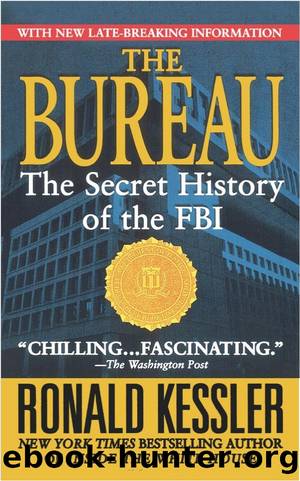
The Bureau: The Secret History of the FBI by Ronald Kessler
Author:Ronald Kessler
Language: eng
Format: epub
Publisher: St. Martin's Press
Published: 2018-09-10T00:00:00+00:00
22
THE CODIRECTOR
Given how successful William Webster had been as FBI director, after Ronald Reagan chose him to be director of Central Intelligence in May 1987, the president cast about for another judge to head the FBI. On the recommendation of Edwin Meese III, his attorney general, Reagan chose William S. Sessions in July 1987.
By all accounts, Sessions was an excellent judge. With white hair that framed his face, Sessions had a wide smile and riveting eyes through glasses with large round lenses. He looked like a country boy, farm-raised, with enough of a Texas twang to make the stories he liked to tell sound authentic. It was the Texas congressional delegation that had suggested him to Meese.
The son of a minister in the Disciples of Christ Church, William Steele Sessions was born on May 27, 1930, in Fort Smith, Arkansas. He graduated from Northeast High School in Kansas City, which Clarence Kelley had attended. When he was a sophomore, he met his wife, Alice, who was going to the same school. She was also the daughter of a minister, but from a different churchâthe Reorganized Church of Jesus Christ of Latter Day Saints. She later became a Methodist.
Sessions attended the University of Kansas and Florida State University before graduating in 1956 from Baylor University and, two years later, from its law school. He served as a first lieutenant in the Air Force and, after ten years of practicing law in Waco, Texas, joined the Justice Department in 1969. There he headed a section that prosecuted draft evasion, pornography, election fraud, and violations of the Foreign Corrupt Practices Act. Having served in 1966 as a county chairman for Senator John Tower, the Texas Republican, Sessions was connected politically. In 1971, he was named U.S. attorney in San Antonio. Three years later, he became a judge at the U.S. District Court in San Antonio and, in 1980, chief judge.
As a judge, Sessions was known for his fairness, toughness, and attention to decorum. He had a self-deprecating sense of humor and put people at ease. Despite a bout with polio when he was sixteen, Sessions was a mountain climber who made two treks up to the eighteen-thousand-foot level of Mount Everest.
Sessions gained national attention when he presided over the trials of defendants charged with assassinating U.S. District Court Judge John H. Wood. Known as a tough judge, Wood was killed just before sentencing Jamiel âJimmyâ Chagra. The bureau solved the case by planting rumors in the prison where Chagra was incarcerated. The rumors prompted Chagra, in conversation with others, to make admissions that the bureau picked up through electronic bugs and wiretaps. Apparently, he hoped to get a lighter sentence by having another judge sentence him.
Accusing Sessions of âunspeakable evilâ and the government of âGestapo tactics,â Charles V. Harrelson, who killed Wood at Chagraâs direction, ranted in Sessionsâs courtroom in San Antonio: âI think the court should consider a charge against itself for rape and murder.â Sessions never flinched. He quietly sentenced him
Download
This site does not store any files on its server. We only index and link to content provided by other sites. Please contact the content providers to delete copyright contents if any and email us, we'll remove relevant links or contents immediately.
Spell It Out by David Crystal(36110)
Life for Me Ain't Been No Crystal Stair by Susan Sheehan(35802)
Cecilia; Or, Memoirs of an Heiress — Volume 1 by Fanny Burney(32546)
Cecilia; Or, Memoirs of an Heiress — Volume 2 by Fanny Burney(31944)
Cecilia; Or, Memoirs of an Heiress — Volume 3 by Fanny Burney(31929)
The Great Music City by Andrea Baker(31916)
Professional Troublemaker by Luvvie Ajayi Jones(29651)
The Secret History by Donna Tartt(19052)
We're Going to Need More Wine by Gabrielle Union(19034)
Twilight of the Idols With the Antichrist and Ecce Homo by Friedrich Nietzsche(18622)
All the Missing Girls by Megan Miranda(15953)
Cat's cradle by Kurt Vonnegut(15334)
Pimp by Iceberg Slim(14488)
Bombshells: Glamour Girls of a Lifetime by Sullivan Steve(14056)
For the Love of Europe by Rick Steves(13905)
Talking to Strangers by Malcolm Gladwell(13347)
Norse Mythology by Gaiman Neil(13345)
Fifty Shades Freed by E L James(13232)
The Social Justice Warrior Handbook by Lisa De Pasquale(12187)
